Introduction
Today we’re heading back to the 1970s—a pretty great decade for trash fans, and for cinema in general, since this era offers something for everyone. There’s a saying (well, not really a saying, more some clever line I once read somewhere) that the decade embodied the “three great Ks”: art, commerce, and nonsense. And today we are, of course, dealing with the latter (and to be honest, this sentence only makes sense in German, not in English. Sorry).
And we’re starting right away with a candidate that is probably only suitable for the hardest of hardcore trash enthusiasts, one that combines two glorious strands of cinema from that era: grindhouse cinema and animal-horror films. Both genres have the advantage that you constantly stumble upon absurd, forgotten “gems” waiting to be rediscovered.
Whether The Worm Eaters qualifies as such a gem is something everyone has to decide for themselves, but the title alone already makes it clear that we’re dealing with a completely deranged moving picture. And on top of that, one with rather unusual “protagonists.” Normally, animal-horror films rely on sharks, spiders, or similar creatures to terrify audiences. But that would get boring over time, and films like Night of the Lepus (killer rabbits), Slugs (killer slugs), or Godmonster of Indian Flats (killer sheep) provide some welcome variety.
And into this illustrious lineup… steps today’s title. Off the top of my head, the only comparable example would be Squirm from the previous year, which put the humble lumbricidae (i.e., worms) front and center. So then—let’s dive into the abyss.
Plot
The opening already shows where this is going. Accompanied by the sweet sounds of something resembling a children’s song, the credits roll by while we get to admire charming children’s drawings in the background—drawings in which worms, of course, also have their place.
The “story” proper begins at night, around a campfire, where three hillbilly fishermen have made themselves comfortable. One of them keeps burping nonstop, while another complains that they haven’t caught so much as a tadpole in the lake so far. His goal is to catch the “champion bass,” but the conversation is suddenly interrupted by a noise in the underbrush. We see a pair of feet, but not the person they belong to, and one of the fishermen claims he has recognized the sound of worms (“I can even hear a tapeworm inside a pig”).
Naturally, this must be investigated. A worm is spotted in the mud and promptly impaled on a fishing hook.
The next scene takes place during the day, and once again we see a pair of feet walking along a stone path toward a staircase. We then find ourselves at the birthday party of a girl named Ursula, as indicated by a banner hanging in the background. The guests immediately break into song, although Ursula’s facial expression suggests she’s not exactly thrilled.
As the father tries to hand Ursula the knife to cut the cake, it’s snatched away by her brother (?). “I want to cut the cake, just like I cut up your doll,” he says. Ursula fires back: “Give me that knife right now, or I’ll kick your ass!”
The argument continues until the father smacks the boy (now that’s what I call parenting). While some old woman expresses shock at the behavior of the mayor’s children, a mustached man can’t stop laughing. Eventually, the cake is cut, and Ursula plunges her hands into it—pulling out several worms hidden inside. The guests flee in disgust, sped up in fast motion and accompanied by cartoonish music. Why some of them try to climb trees in their panic is beyond me, but whatever.
The next scene—and really the first one with anything resembling plot—shows the mayor and his assistant strolling through nature. The mayor explains that three fishermen disappeared at the lake six months ago, which conveniently aligns with their plans, since the evil capitalist wants to cover everything in concrete to attract tourists.
The problem is that Herman Umgar, a German hermit (at least according to IMDb—so much for Germans always being cast as villains), still lives by the lake. Since his father was once friends with the mayor, Umgar owns half the town. His father drowned years ago when a dam broke—apparently due to the mayor’s fault—making the mayor indirectly responsible for his death.
The goal, then, is to get rid of Umgar, or at least take the deed to his land away from him.
Meanwhile, Umgar tends to his worms, chats with them, and complains about the smell (where that might be coming from is anyone’s guess). The mayor later confronts the poor hermit and spins a story about wanting to build a museum—perhaps Umgar could donate some valuable possessions, like a deed? When Umgar says he doesn’t have one, the mayor snaps, starts yelling, and storms off.
Later, he confers with his assistant, who would rather rip Umgar’s heart straight out of his chest, but the mayor instead decides to convene the “Council of the Great Ms”… whoever that might be.
Review
And with that, the roles should be clear: the poor little man versus the powerful elites. But anyone expecting the story to actually build on this conflict is sorely mistaken. In fact, that brief summary of the first fifteen minutes is already the most coherent thing the film manages to pull off.
That we’re dealing with ultra-trash becomes obvious from the macabre intro and spätestens when the party guests flee in fast motion. This is pure, pointless slapstick, and that part immediately reminded me of the third segment of the horror anthology The Tongue of Death, which I rated at seven beers because I can enjoy absurd, goofy humor—at least occasionally.
With The Worm Eaters, however, that seems to be the entire point. The film isn’t entirely made up of humor or slapstick, but it’s also not meant to be taken seriously—at least I hope not. It’s hard to pin down what this film even wants to be. Is it a comedy? Is it, at least partially, an animal-horror movie?
The most plausible explanation is that some folks in the American South went fishing and decided to make a movie. The result is 86 minutes of deranged nonsense unlike almost anything I’ve ever seen.
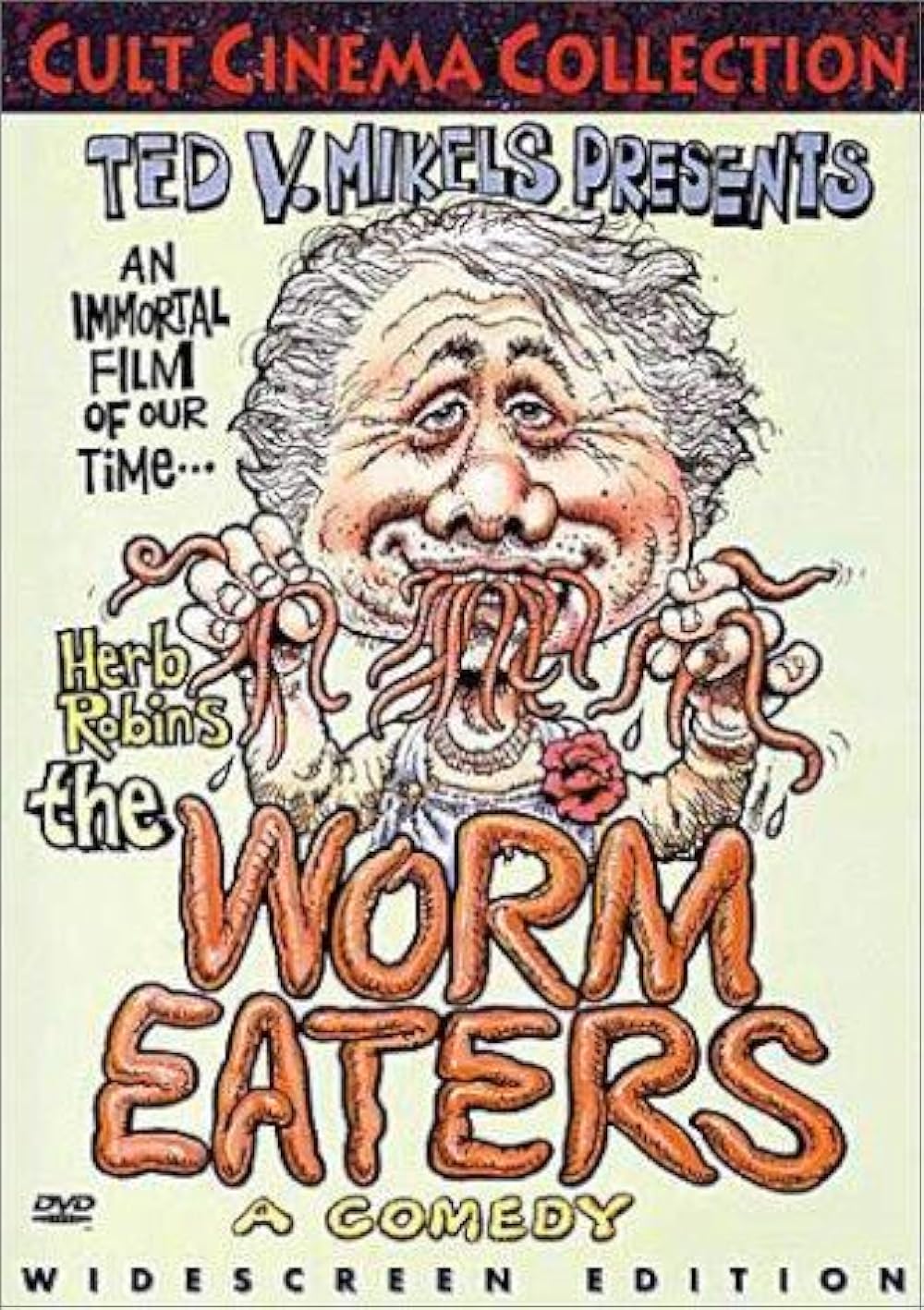
To make matters even better, the film was produced by none other than Ted V. Mikels, who enriched the trash world with productions like The Corpse Grinders and The Astro-Zombies. That was grindhouse cinema par excellence, and played straight as horror or sci-fi—something that clearly cannot be said here.
The film was helmed entirely by Herb Robins, who served as director, writer, and also played the deranged protagonist and worm enthusiast Herman Umgar. The “basic idea” came from someone named Nancy Kapner (I’d really love to know what that original idea looked like).
The screenplay is a collection of the most absurd ideas imaginable. There is practically no linear story, and the film constantly wastes time on pointless scenes and subplots. The basic framework of “Herman versus the mayor” appears only at the beginning and the end.
In between, we follow, among other things, a group of tourists camping on Umgar’s land, which has absolutely nothing to do with the “main plot.” They complain about Umgar’s food (one woman wants muesli—Umgar has no idea what that is), the son photographs random women, and eventually a Black archaeologist and an environmental activist show up. Umgar meets the latter in a shop while trying to buy a “Bulla-Ball.”
What any of this is supposed to mean remains a mystery.
About 95% of the film consists of nonsense, staggering stupidity, and absurdity that makes you want to clutch your head in disbelief. The dialogue is borderline moronic, and you seriously wonder what Robins—who otherwise only directed The Brain Sucker (1988)—was thinking. The film’s “humor” comes almost exclusively from hurling the dumbest possible dialogue and characters at the viewer.
There’s a bit of slapstick here and there, but very little that could be defined as an actual joke. It’s pure dadaism, nihilism—no other words really come to mind.
The film is never exciting, and the numerous filler scenes (Umgar talking to his worms or dancing with one of them in the forest) quickly become mind-numbing. The first worm isn’t eaten until 42 minutes in. As expected, the victim (who didn’t notice the worm in the food) transforms into a giant worm—well, at least from the waist down, resembling someone stuck in a sleeping bag. Mentally, the victim seems to regress to prehistoric times, loses the ability to speak, and is locked up by Umgar.
In terms of effects, there’s very little to expect. There’s hardly any body horror or splatter. Instead, the film indulges in close-ups of mouths devouring food or worms in the most disgusting way possible. I personally find spiders more repulsive than worms, but this was still not pleasant to watch.
Eventually, the three fishermen from the opening return, presenting themselves as a new super race. After eating the fish they caught with Umgar’s worms, they transformed and are now “half man, half worm”—and demand women to expand their race.
But even at the end, the film doesn’t pick up steam. It feels like Robins simply said, “Screw it.” The main conflict with the mayor—who barely appears in the middle section anyway—is wrapped up quickly and without any fanfare. Then the super worm-men show up again, and from that point on, I completely lost it.
Using a fishing rod, they pull Umgar out of his house and force worms into his mouth, turning him into one of them. He crawls through the underbrush until he’s run over by a truck. In between, there’s also a woman lying in bed with one of the worms and later showering with it.
I am at a loss in the face of this sheer stupidity, which is almost impossible to fully process. It’s a cacophony of madness (a phrase I’ve been wanting to use for a while).
So much for the plot, which easily deserves ten bombs: incoherent, long-winded, pointless, and utterly idiotic. Technically, things don’t look much better. To be fair, the film doesn’t feel quite as cramped and barren as Mikels’ The Corpse Grinders, but that’s largely because The Worm Eaters takes place mainly in Umgar’s house, the town, and the surrounding countryside.
Umgar’s house is at least “nicely” dressed: worm cages, worm containers, and a trapdoor in the floor emitting steam. There’s even a poster for the film All Through the Night hanging on the wall. Special effects are virtually nonexistent, aside from the aforementioned “worm costumes,” which are as unspectacular as you’d expect.
The camera is at least somewhat more mobile and occasionally offers a bit of variety through landscape shots. As for the soundtrack: the credits list an apparently original song titled “In the End You Will Eat Worms,” which plays during a scene of Umgar driving through town. Speaking of the town—on every corner, you see lunatics beating each other up, so Umgar is clearly not the only one with a screw loose. For the soul, however, the film offers moments of unintentional poetry, such as when Mozart’s Für Elise plays during a melancholic scene of Umgar mourning a worm.
The sound effects for the human worms, on the other hand, defy description.
Acting-wise, this is obviously bottom-of-the-barrel. Many of the amateur actors overact or deliver absurd facial contortions. Herb Robins—who also appeared in Mikels’ The Doll Squad—fits the role perfectly. I honestly believe he’s like this in real life; otherwise, how would anyone come up with something like this?
The only performances that strike me as relatively “serious” and not completely unhinged are those of the environmental activist and the archaeologist, played by Claudette Wells. This was her first role, and she apparently worked until 2014, including television and voice acting. Under “additional crew,” she even has credits on films like Kill Bill and Dawn of the Dead (2004).
How the film made it to Germany remains a complete mystery to me. Of course, CMV picked it up and released it as number 7 in their legendary Trash Collection in a neat little hardbox—where it absolutely belongs. To my knowledge, it was later also released on VHS.
Conclusion
The film left me baffled—utterly and hopelessly. It is genuinely one of the most absurd films I have ever seen. Not the worst by a long shot, but unfortunately not a positive experience either. The length, the pointlessness, and the sheer stupidity of the almost nonexistent story simply outweighed everything else.
I put the disc into the player with genuine curiosity and hope, but in the end, all that remained was disappointment. Ultimately, this is nothing more than a cheap, insane, brain-dead “film.” Only the hardest of hardcore trash fans should dare approach it.