Introduction
Today, we journey into the future. But not just any future—into a dystopia, a negative vision of what is to come. More precisely, into the year 2071, or rather into the year 1964’s idea of 2071, the year The Time Travelers was produced. What this is all about becomes clear fairly quickly, because although the German distributors translated the original title The Time Travelers in the most sensationalist way possible (including spelling errors), the German title isn’t actually all that wrong (the German title literally means “2071: Mutan-Beasts against Robots, including the missing “t”!)
The distributors seem to have actually watched the film, because it really is about robots (or androids) and mutants beating the hell out of each other. Even the year 2071 is correct. Why the German poster spells it “Mutan” instead of “Mutant,” however, will probably remain a mystery forever.
Plot
In his laboratory, Dr. Erik von Steiner is just about to test his great invention: a screen that allows him to look into the future. The device consumes enormous amounts of power, prompting a nearby power plant to send technician Danny to shut the experiment down. But the screen works and soon shows them the laboratory grounds as they will appear in the year 2071.
At the same time, the machine catches fire, and the scientists realize that the screen has created a portal into the future. Danny, of course, immediately steps through and disappears into the stone desert of the next century. The scientists follow him shortly afterward, but returning is not so easy—the portal collapses behind them.
Review
Ah yes, the future. Time travel has always been one of the most interesting and diverse subgenres of science fiction—at least since H. G. Wells firmly established the idea with his novel The Time Machine in 1896. In The Time Travelers (I’ll stick with the simpler original title from here on), there is no classic time machine, but rather a time portal that catapults our four curious—or rather reckless and thick-headed—scientists into the year 2071.
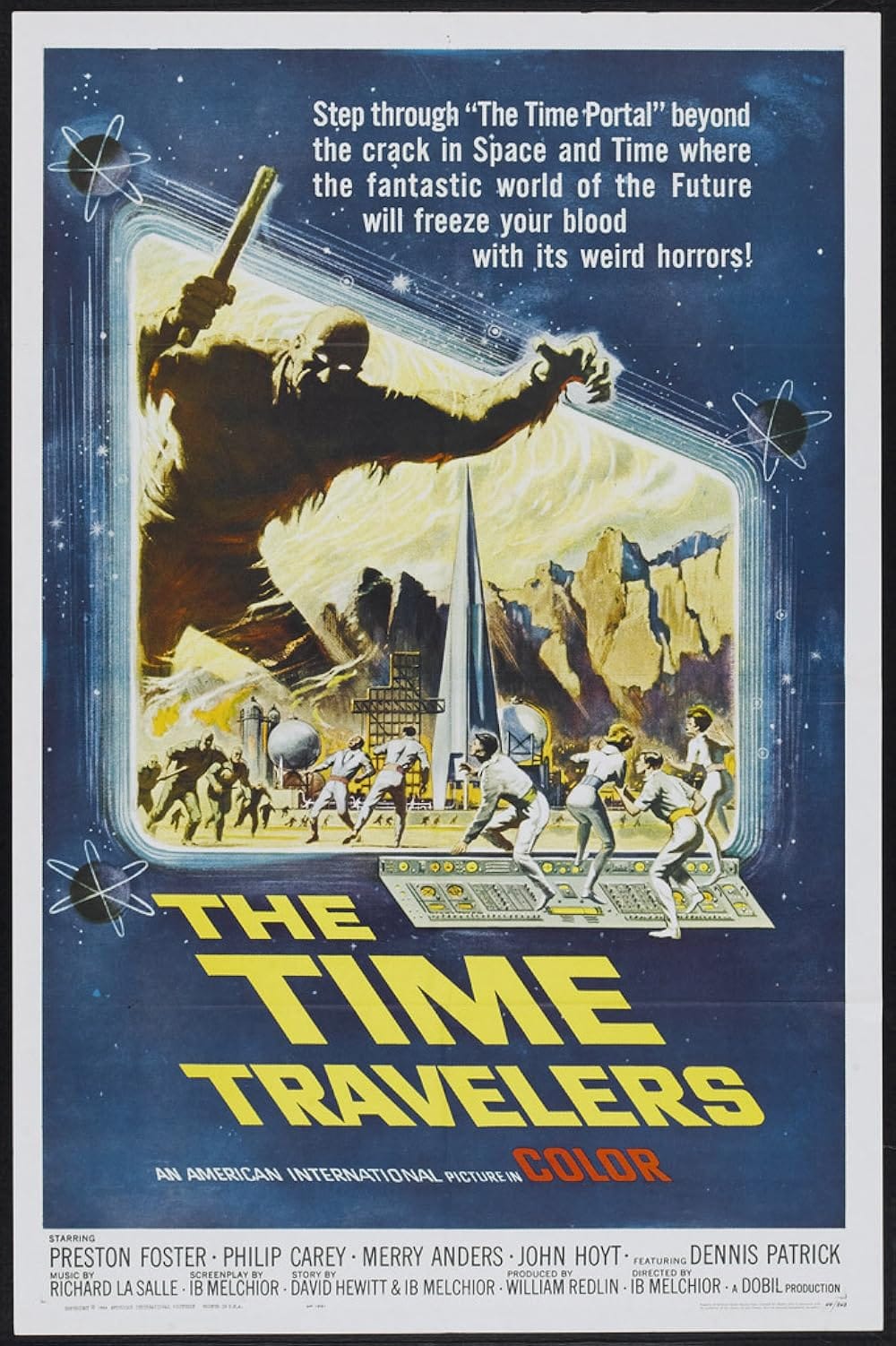
In essence, what we get is a classic dystopia. Humanity has wiped itself out through nuclear war, the surface of the Earth is dead and barren, and the survivors roam the wasteland as bald mutants, attacking anything they can get their hands on. Underground, however, the last bastion of civilization has entrenched itself, working on a rocket to leave Earth behind. A similar setup had already appeared in World Without End (1956).
As mentioned earlier, the German title is largely accurate. After the opening in the laboratory and the arrival in the world of 2071, the scenario is explained in detail once the scientists come into contact with the underground civilization. While the surface is a rocky wasteland, the subterranean “bunker” turns out to be a delightfully playful and kitschy stage for retro-futuristic sets. Everything blinks and sparkles, there are wide consoles with colorful switches, and of course, an android manufacturing facility.
The helpers produced there look… well, let’s just say their design is rather obscure, though it certainly fits the overall character of the film—which is that of a classic B-movie from the 1950s and early 1960s: naive, pseudo-philosophical, and pseudo-scientific. Add to that some charming (and occasionally idiotic) creativity and a dose of pathos.
The film cost $250,000 and was produced by AIP, founded by Corman, Nicholson, and Arkoff—famously a supplier for drive-in theaters, which flooded screens from the 1950s through the 1970s with endless howlers. As such, one shouldn’t expect lavish sets or visionary special effects. Sure, by 1964 a lot was already technically possible—just look at 2001: A Space Odyssey (1968), released only four years later—but such a comparison would be nonsense. The Time Travelers aims to provide simple matinee entertainment.
Does it succeed at that? The sets do look genuinely nice and offer some amusement, whether it’s people fiddling around on the utopian “light organ” or taking a look at the android workshop. In the background, you can also admire classic matte paintings. For $250,000, it’s nicely staged—certainly not lavish, but satisfactory for fans of this kind of fare.
The design of the androids and mutants looks somewhat unintentionally funny today. They’re essentially costumed extras in cheap but amusing outfits. The special effects are nothing surprising either, but they’re not so cheap that they become laughable. There’s not much to mock here: they’re easy to see through, but practical and competently executed—the three-dimensional portal, the “light organ,” or the “screens” capable of receiving images. A model rocket even evokes a faint kaiju-like feeling. The final battle between mutants and androids—since they only really encounter each other once—is delightfully silly, though it’s also very brief.
These are undoubtedly the film’s strengths: a likable B-movie aesthetic. On the downside, however, the screenplay often drags and becomes boring over its 80-minute runtime. It was written by David L. Hewitt, who as a writer, director, and special effects artist brought various pieces of sci-fi schlock to the screen, including Wizards of Mars (1965), Journey to the Center of Time (1967), and Mighty Gorga (1969). This was his first screenplay, and it shows—the pacing is simply off. Judging from the Doc’s reviews, he didn’t seem to have much more up his sleeve as a director either.
Direction was handled by Ib Melchior, a name that should be familiar to trash enthusiasts. The Danish-born director made films such as The Angry Red Planet (1959), the absurd Reptilicus (1961), and later The Devil’s Rain (1975). He also co-wrote the script here.
After the brisk opening and the mutant chase, the film settles into a very long tour through the underground corridors. The construction of the androids is shown at length and accompanied by an annoying soundtrack. There’s even some slapstick thrown in, which doesn’t really fit the otherwise serious tone of the film. Beyond that, we get endless explanations, overextended dialogue, and the highlight of the long-winded middle section is a mutant sneaking into the storage room.
The dialogue isn’t so wooden, and the acting not so terrible, that it becomes easy to ridicule. The film takes itself very seriously, and atomic annihilation was likely a more immediate concern in the 1960s than it is today. Romantic subplots are, of course, unavoidable.
What’s interesting is that the underground world has no caste system. Everyone is equal and works together toward a single goal. The sometimes annoying zeitgeist of the 1950s is somewhat toned down here, and the film doesn’t come across as overly heavy-handed. Women work alongside men as equals, initiate romances themselves, and aren’t reduced to pointless side characters whose sole purpose is to be rescued.
That said, the characters remain fairly clichéd overall. With an 80-minute runtime and endless sequences that are ultimately irrelevant to the ending, there’s simply no time for deeper characterization.
This brings us to the cast. The aging, inquisitive Dr. von Steiner is played by Preston Foster. The former bus driver became known for his role as Dr. Wells in Doctor X (1932) and later appeared mainly in B-movies. This film marks his third-to-last role. Opposite him is Dennis Patrick as Councilman Willard, who gets to deliver pompous dialogue and look serious at all times. He mostly worked in television and had no particularly notable film roles otherwise. The same is true for most of the remaining cast.
It’s also worth mentioning that sci-fi icon Forrest J. Ackerman makes a cameo appearance as a technician.
The ending is also notable. There’s no classic happy ending, but rather an open and fairly interesting conclusion, allowing the film to at least end on a stronger note. After all, the concept of time loops wasn’t as firmly established back then as it is today.
Conclusion:
In the end, the film isn’t quite as entertaining as one might hope given its title. The basic premise is interesting, and the existing effects provide some charming B-movie entertainment, but the screenplay is ultimately too sluggish to sustain enjoyment throughout.