Introduction
When I was away from home for a few days and therefore couldn’t access my film collection, I had to rely on the offerings of the usual streaming services. Since those are rather poorly stocked with titles that would potentially deserve a review on a site called Badmovies, I didn’t have much luck.
So, after a long time, I opened Plex again and browsed through the countless free films in the horror and science-fiction categories—pretty much all of which would be worth reviewing. Most of them are forgotten Z-movies that have fallen into the public domain, which explains why The Capture of Big Foot and Curse of Bigfoot can also be found there.
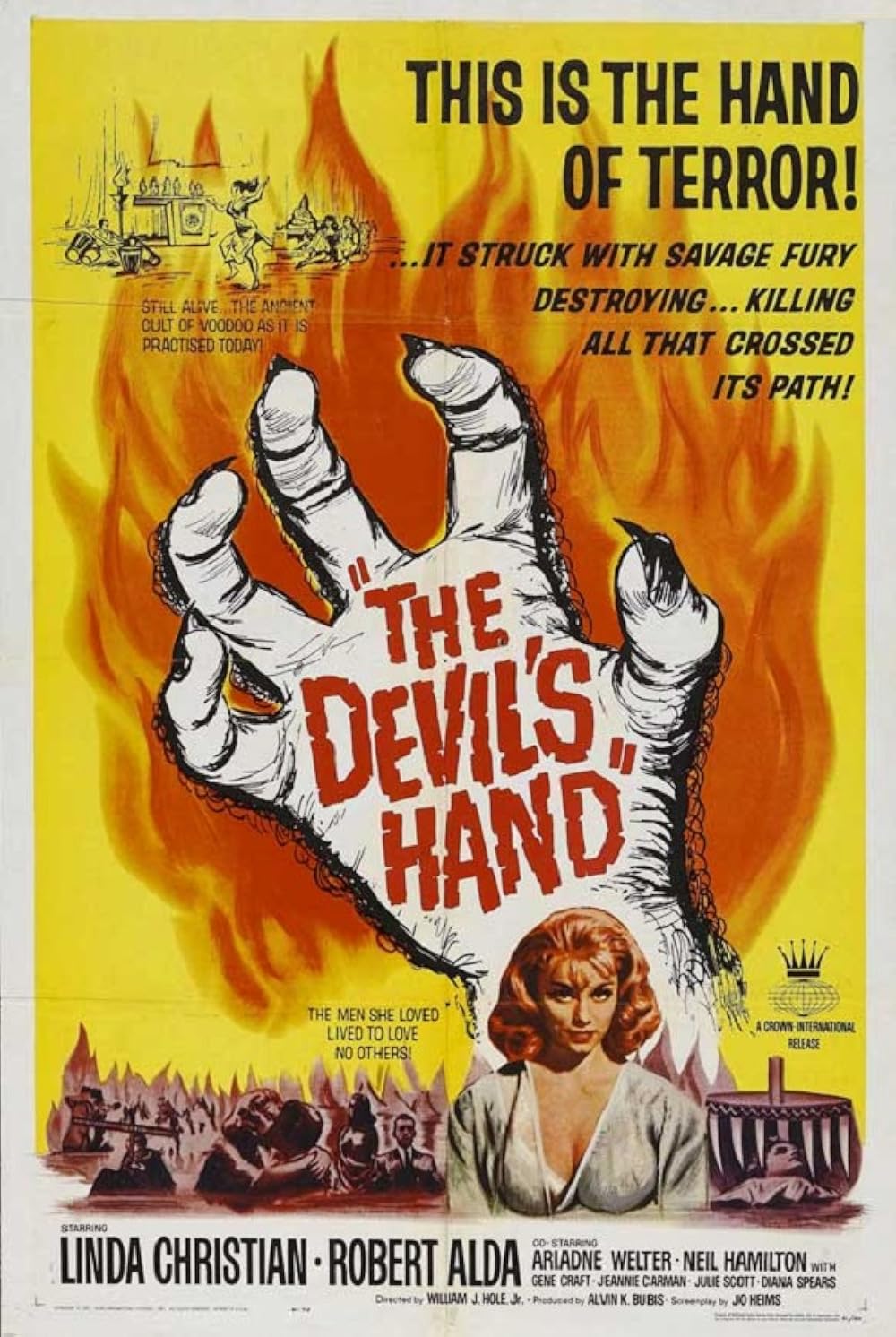
That’s where I stumbled upon today’s candidate, The Devil’s Hand, which immediately caught my attention thanks to its title and poster—and which should not be confused with Macabra (released in Germany as Die Hand des Teufels, “The Hand of the Devil”). In Germany, the film later aired on television under the title Im Banne der Puppe, and since 2015 it has been available on DVD as Im Bann der Teufelsklaue, “Under the Spell of the devil’s Claw". On Plex, however, it’s naturally only available in its original version.
Well then—let’s dive into the “fun.”
Review
Even the brief plot synopsis already makes it clear that this is one of those films in which an average Joe gets caught up with evil sects and demon cults. This theme was explored in countless variations during the 1960s and 1970s—for example Blood Orgy of the She-Devils (1973), Hammer’s The Devil Rides Out (1968), and, of course, Manos: The Hands of Fate (1966), just to name a few.
I came across The Devil’s Hand primarily because its producer might not be unfamiliar to seasoned B-movie connoisseurs. We’re talking about the busy and savvy businessman Rex Carlton, who started his career working carnivals and continued it in the film industry from 1949 onward. He initially focused on film noir and crime films, only venturing into fantastic territory toward the end of the decade.
There, however, he co-produced the rather respectable The Brain That Wouldn’t Die with Joseph Green—a film that AIP didn’t release into drive-ins until three years later, in 1962, and which remains memorable today mainly because of its surprisingly harsh effects for the time. The Devil’s Hand suffered a similar fate: completed as early as 1959, it wasn’t released until later, eventually finding a home in 1961 with the low-budget outfit Crown International Pictures.
Personally, I would have preferred if Carlton had stuck to monster nonsense à la The Brain That Wouldn’t Die, because as exhibitionistic as he was with that film, he’s downright “unspectacular” here. Unfortunately, things never get much more horrific than what’s already described in the synopsis. The cult’s devilish activities never culminate in the appearance of demons, zombies, or deities, nor are the cult members themselves particularly bloodthirsty.
The spectacle is limited to a few voodoo dolls, unimaginatively staged rituals, and the cult itself. Carlton never had a large budget at his disposal—nor in his later projects—but in The Brain That Wouldn’t Die, this was compensated for by its peculiar atmosphere and trashy effects. Atmosphere and a distinctive visual style are almost completely absent here, however, as the set design is anything but lavish.
Most of the story takes place in various apartments and in Lamont’s doll shop, with an adjoining Satanist church. For the latter, they apparently just stepped into the Chinese shop around the corner. Aside from a Buddha statue, a Greek bust, a few fire bowls, and a cheap plastic podium, there’s nothing noteworthy to see. The set is further dressed up with random curtains. Unsurprisingly, none of this creates a dark or eerie atmosphere.
The few dream sequences are achieved through simple dissolves, and the rituals consist of a wheel with plastic knives being lowered onto a victim lying on the floor. The wheel doesn’t even rotate on its own—it has to be pushed by High Priest Lamont using a pole, before being lowered via foot pedal. Naturally, a drummer and some absurd dance routines are also mandatory.
Of course, a film about an evil cult doesn’t necessarily need impressive effects. Unfortunately, The Devil’s Hand doesn’t fare much better in other areas either.
The screenplay—written by Jo Heims, who would later become Clint Eastwood’s girlfriend and write his directorial debut Play Misty for Me (1971)—at least starts off by jumping straight into the mystery. After barely 15 minutes, we’re already in the voodoo doll shop, which does create a certain baseline of tension. Sadly, this dissipates again during the sluggish middle section, where the story barely moves forward.
Rick is completely smitten with the beautiful Bianca and appears to be basking in wealth with her—or at least that’s what a scene involving a puzzled businessman wondering why Rick suddenly has such luck on the stock market wants us to believe. We don’t actually see any of that wealth, though.
While Rick struggles internally—still harboring feelings for his fiancée while trying to remain loyal to the cult—there’s little of interest happening on screen. At the same time, a subplot involving an unfaithful cult member is introduced, but it’s quickly dispatched in a voodoo sequence. The traitor’s subsequent car accident is realized using miniatures.
In this context, we also get a brief glimpse of Bruno VeSota, who collaborated with Corman several times in the 1950s and even directed The Brain Eaters.
Unfortunately, the screenplay remains unexciting and far too superficial. Many questions go unanswered: why did Bianca choose Rick in the first place, and what exactly does the cult even do? Some character behavior is also baffling. Donna, who remains confined to her hospital bed, shows little interest in where Rick has been spending his time and doesn’t question him during his overdue visit—even though she previously wrote him a letter claiming she’d been looking for him for weeks.
Rick’s sudden change of heart toward the end also feels rushed. Ultimately, the script is simply too shallow. The direction by William J. Hole Jr. doesn’t help matters either. He had previously directed AIP’s horror-comedy Ghost of Dragstrip Hollow and mainly worked in television. Here, he brings nothing distinctive to the table, injects no momentum into the story, and the static camera work only adds to the lack of dynamism.
There’s also little dynamism to be found in the cast. Robert Alda, father of actors Alan and Antony Alda, doesn’t seem particularly enthusiastic and delivers the emotional scenes rather unconvincingly. He had prior experience with “hand horror” back in 1946 in The Beast with Five Fingers.
Rick’s fiancée Donna is played by Mexican actress Ariadne Welter, who appeared in numerous horror films in her home country, including The Brainiac, The Vampire, and The Curse of the Crying Woman. Here, however, she leaves no positive impression, remaining largely expressionless and sporting the same look throughout.
Neil Hamilton appears as cult leader Francis Lamont, best known for his role as Commissioner Gordon in the TV series Batman. He brings a certain sinister charisma to the role, but never makes it truly memorable. At the very least, there are no outright disasters among the performances.
Conclusion
The Devil’s Hand is not a total failure, but unfortunately, it’s far from an entertaining hidden gem. In the end, it proves to be too sluggish, dull, and unspectacular, despite its short runtime of just under 70 minutes. The material might have been better suited for a shorter television episode or as part of an anthology.
Rex Carlton continued producing films, including the fairly enjoyable Chamber of Horrors (1969), and teamed up with prolific trash filmmaker Al Adamson the same year for Dracula vs. Frankenstein. Sadly, he also took his own life that year, allegedly due to financial dealings with the Mafia.
The Devil’s Hand, however, ultimately offers neither great trashy entertainment nor serious appeal, being far too crude and boring for either category.