Introduction:
The splatter film has a long history—maybe not as long as some other (sub)genres, but certainly a very colorful one, heavily shaped by censorship and bans. It all began in the early 1960s, more precisely in 1963. While audiences in Germany were enjoying harmless crime thrillers in the style of Edgar Wallace, a trash-loving advertising artist from the US named Herschell Gordon Lewis started cooking up the first gore films for hungry drive-in theaters.
Blood Feast is generally regarded as the first genuine splatter film and marked a new turning point in film history. In its wake came more and more productions designed to shock bloodthirsty audiences. Lewis himself directed numerous such films, and the escalation continued. After movies like George A. Romero’s Night of the Living Dead (1968), the 1970s saw another wave of terror and splatter films, fueled by Wes Craven’s The Last House on the Left (1972) and Tobe Hooper’s infamous The Texas Chain Saw Massacre (1974)—even if these films may seem almost tame by today’s standards.
The development was unstoppable, and when VHS entered the market, the number of such productions exploded. The zombie wave brought ever bloodier films like Fulci’s Zombie (1979) or Romero’s Dawn of the Dead (1978). But another kind of excess violence emerged as well: fun splatter, films that didn’t take themselves quite so seriously.
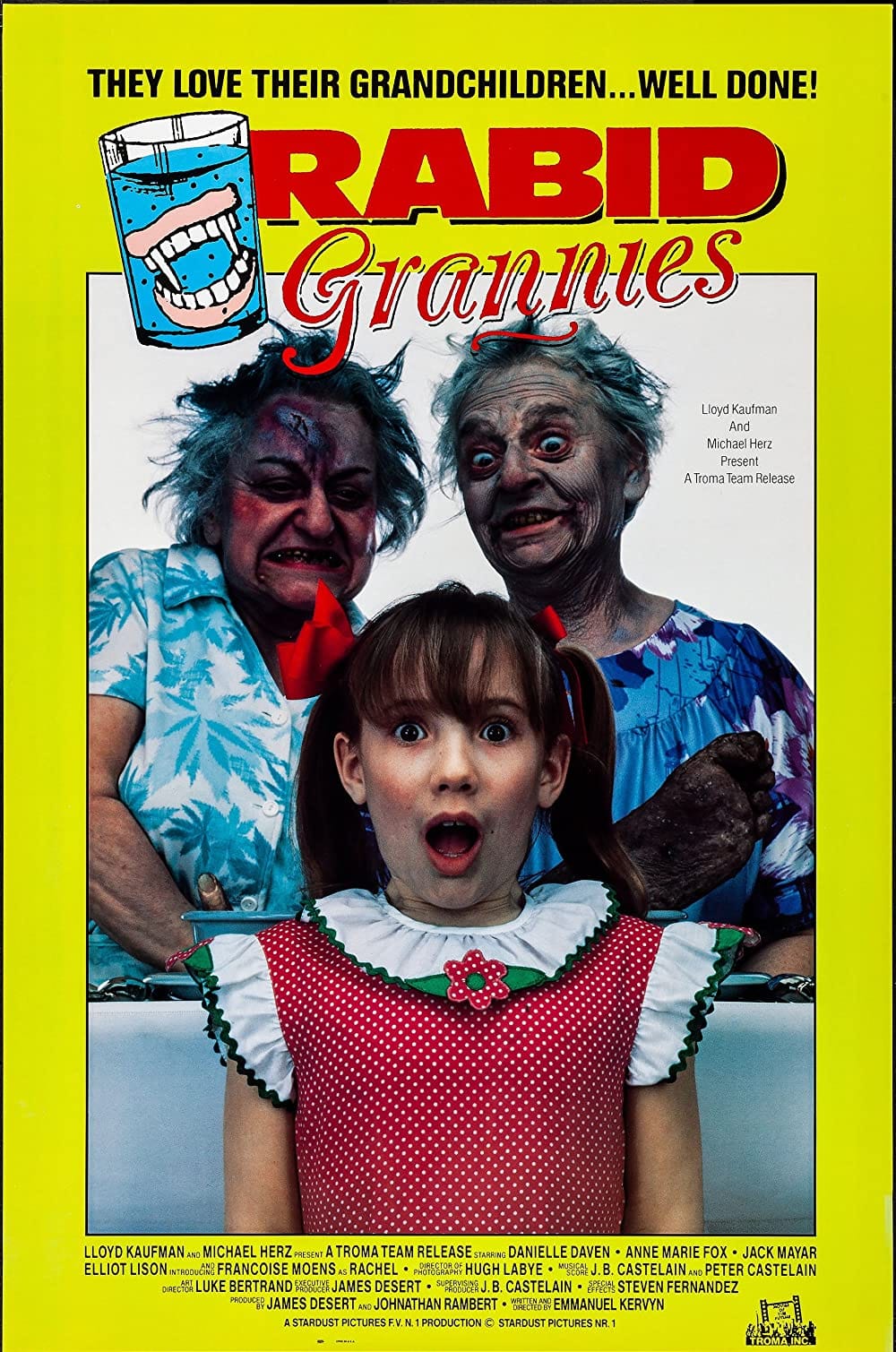
And no company is more closely associated with that subgenre than Troma Entertainment, which celebrated major successes with so-called “cult classics” like The Toxic Avenger (1984) or Mother’s Day (1980). The film discussed here was also distributed by Troma: Rabid Grannies (1988) - or, in its wonderfully fitting original title, Les mémés cannibales. It is not only one of the few Belgian splatter films of its time, but also a trash oddity that definitely deserves closer inspection.
So let the Troma fanfare blare and head to western Flanders!
Plot
After the trumpets of the Troma intro fade away, we witness a priest taking time off to attend the birthday celebration of his beloved aunts Victoria and Elizabeth. And those two old (and apparently very wealthy) ladies are just returning to their estate, where the grumpy cook comments on the expected arrival of the hunchbacked relatives with a beautiful metaphor: they’re like a stillborn calf—soft and nice on the outside, but nothing underneath except maggot-eaten flesh.
The entire village knows it: the nasty relatives aren’t coming to congratulate the elderly ladies out of love, but to suck up to them in hopes of securing their inheritance.
And one by one, they arrive. There’s the uncompromising weapons manufacturer who wants to sell his guns to Islamists, the Chinese and the Russians; the fat, environmentalist-hating businessman and his dim-witted wife; a lesbian couple; a dull married pair with two annoying brats; an arrogant young snob; and finally, the priest himself.
Once everyone has arrived and—well—after some heartfelt greetings, the grand dinner begins, with everyone trying hard to convince the old ladies of their own superior morals. But there’s one more surprise: a mysterious woman delivers a package from the family’s black sheep—a Satanist who ended up in prison after a graveyard celebration. He now asks for forgiveness and has sent along a wooden box as a peace offering.
Smoke pours out of it and mixes with the drinks, which the old ladies promptly gulp down. And then, as is customary at family gatherings: the grandmothers (actually aunts, but who cares) transform into bloodthirsty demons—first cutting the cake, then the guests.
Review
Yes, this plot summary—and really the entire “story” and presentation—fits perfectly with the cheap and insane trash films that Troma Entertainment absorbed into its catalogue during the 1980s. Not films they produced themselves, but titles they picked up and threw onto the booming VHS market.
And it shows. The film is extreme and obviously not meant to be taken seriously, but it is also far from being a cartoonishly over-the-top Troma in-house production like THE TOXIC AVENGER, where Lloyd Kaufman and Michael Herz were directly responsible for the madness.
Overall, RABID GRANNIES lives a rather obscure existence and never gained much recognition, even within Troma’s own filmography. On IMDb it scrapes by with a measly 1,800 ratings, averaging just 4.8 out of 10. Sure, it’s no splatter masterpiece like Braindead (which would follow four years later), nor an icon like Bad Taste, but it can still hold its own as part of a respectable splatter collection - provided expectations are kept in check.
A look behind the scenes reveals that the production was largely amateur. It remains the only film directed and written by Emmanuel Kervyn, who otherwise appears only once more in the credits—as an actor in a martial arts film. The acting direction is similarly unpolished. Unlike Kervyn, a few performers had minor roles in other film and TV projects, but the two dear grandmothers (or aunts) never appeared on screen again. Their roles as cannibal retirees were their last—unless a comeback is secretly planned.
Complicating matters further, the French-speaking amateur actors clearly struggled with English, as the film - despite the Belgian production team - was shot in that language. Many performers reportedly learned their lines phonetically, with post-dubbing done later. Speaking of dubbing: the German dub is occasionally strange and obviously low-quality, but it doesn’t hurt the film’s entertainment value either.
All in all, no great performances should be expected—but given the circumstances, the cast does a decent job. Their clichéd characters are portrayed with a bit of humor, which is really all the film demands.
What really matters here—or rather, what matters most—are the splatter effects. It takes about half an hour before the grannies accept the devilish gift and truly go off the rails, but the runtime up to that point is filled reasonably well with character introductions. Once the effects kick in, they’re cheap but effective: slime, spit, and transformations abound, resulting in creatures that reminded me of a bizarre mix between Gingerdead Man and the final stage of the Fly from, uhm, The Fly.
The grannies don’t look like they do on the cover - instead, they’re far more monstrous and bestial. They don’t just go crazy; they turn outright diabolical. After an initial beheading at the dinner table, there’s a brief lull, as the remaining characters scatter into different rooms and discuss their situation. The middle section slows down a bit, with effects spread more sparsely.
Toward the end, however, things get brutal again: the fat guy stuck in a window is literally torn open from behind, another character is impaled with an axe. All of this is accompanied by the grannies’ ironic one-liners and constant giggling as they feast on blood and entrails.
Some additional creativity wouldn’t have hurt to enrich the story, but there’s enough here to fill the short runtime and place the effects into a somewhat coherent context. The monk also allows for a few jabs at the Church, though genuine self-irony is largely absent—something that simply wasn’t as common back then as it is today.
The camera does its job well, capturing the carnage clearly even during more hectic scenes. Occasionally it even gets creative, such as a full 360-degree rotation when the mother walks down the stairs. Complaints are unnecessary. Musically, the film opens with a surprisingly classy score that emphasizes the elegant estate of the elderly ladies.
Naturally, the film was released on VHS back in the day. Today it’s available as a Blu-ray/DVD combo directly from Troma. In Germany, options are more limited—I personally own the XT-Video release in a small two-DVD hardbox, which I picked up cheaply at a convention. The extras are solid, and although the back cover warns that little good source material exists, the picture and sound quality are acceptable under the circumstances. Bonus features include two additional cuts, various interviews, and a very short but largely uninteresting making-of.
Conclusion
All things considered, I can say that the film entertained me quite well. For what it is—a cheap Troma splatter farce—it works. Genre fans who aren’t expecting the ultimate splatter feast should give it a look. It’s a likable little relic from a bygone era, made by an amateur crew, and that’s precisely why I have a soft spot for it.
It’s not a huge surprise - but as a quick fix, the splatter fan should walk away satisfied.