Introduction
Horror anthologies have enjoyed great popularity for many years, so it’s hardly surprising that there are not only countless examples in literature, but also in fantastic cinema. In earlier decades, these films mostly originated in Great Britain, primarily from Amicus Productions, which—using horror stars like Peter Cushing and Christopher Lee, who were actually part of Hammer’s regular roster—produced numerous films consisting of several smaller horror episodes.
Among them were fine examples such as Dr. Terror’s House of Horrors (1964), Torture Garden (1967), Tales From The Crypt (1972), or Asylum (1972). Between 1965 and 1974, Amicus produced a total of seven horror anthologies, and as the classic Hammer-style horror films started to lose steam in the early 1970s, anthology films became almost the studio’s exclusive output.
In the second half of that decade, the flow of horror anthologies slowed down, until Creepshow (1982), based on a story by master author Stephen King and directed by George A. Romero, became a major success. Not only did the film spawn two sequels, but it also inspired further anthology projects such as Nightmares (1983), and a bit later, a film with the rather peculiar German title Die Zunge des Todes (Literally “The Tongue of Death”! What was the marketing man thinking again…?).
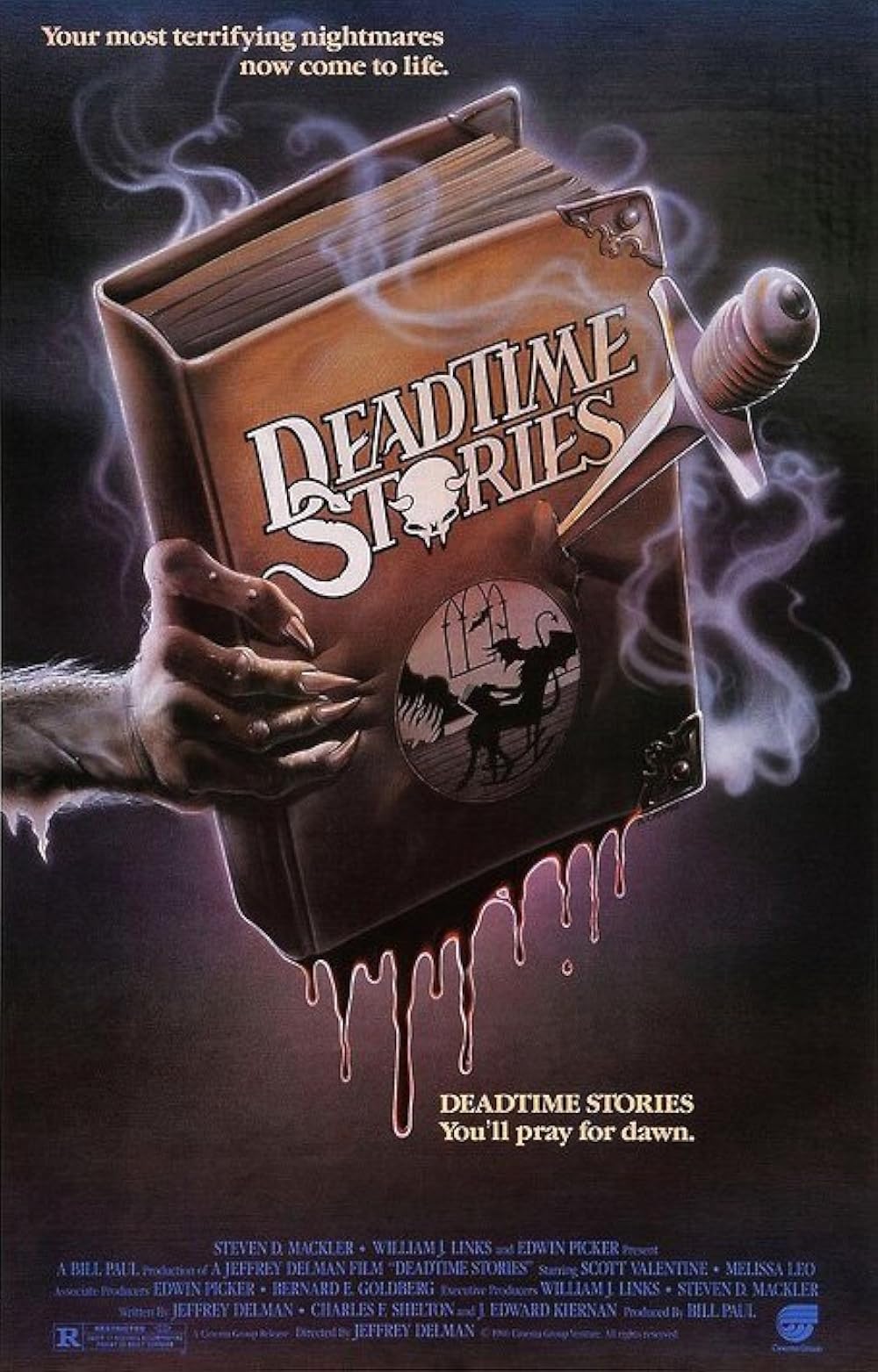
As is often the case, the English title makes far more sense (here in Germany, the movie is called literally “The Tongue of Death”!) and already indicates the direction: Deadtime Stories - creepy bedtime stories.
Plot
Who didn’t experience this as a child? Lying awake in bed, the room dark, long past bedtime, unable to fall asleep—and to make matters worse, afraid of monsters lurking in the closet or under the bed. That’s exactly the situation young Brian finds himself in, forcing his annoyed Uncle Mike to step in and help calm the boy with a few nice bedtime stories.
But not those boring fairy tales his mother tells—something better, something more exciting! And so Uncle Mike spins his own twisted versions of classic fairy tales…
Once the framing story is established, we’re treated to the first tale, “Peter and the Witches.” It centers on two old witches who exploit poor Peter as their servant, forcing him to do their dirty work—such as luring a priest into the forest under the pretense that beautiful women await him there, or digging up the coffin of the witches’ deceased sister and transporting it by cart. She is meant to be resurrected through a ritual.
The second story, “Little Red Riding Hood,” is a modern reinterpretation of the famous fairy tale, placing the helpless girl—now a young woman—into the contemporary setting of the time, where she encounters a vicious werewolf. He happens to be a well-known drug dealer, and when he crosses paths with Red Riding Hood at a pharmacy, where she is simply trying to get medicine for her grandmother, a fatal misunderstanding unfolds.
The third story, “Goldilocks,” is an especially bizarre take on Goldilocks and the Three Bears. Here, Goldilocks is reimagined as a serial killer with magical powers. The three bears aren’t exactly innocent either, as they’re portrayed by the deranged Bear family, whose male members (father and son) effortlessly escape from a supposedly high-security mental institution for hopeless cases.
Together with Mother Bear, they flee into an old house—coincidentally the very same one currently occupied by the insane Goldilocks, who conveniently uses it as a storage space for corpses.
Review
As with many horror anthologies, the quality and style of the individual segments vary - and that’s also the case with Deadtime Stories, though here it mainly affects the manner of presentation. The framing story itself isn’t particularly important and is staged without much spectacle, but it serves its purpose of tying the individual episodes together.
Worth mentioning right away is the nicely designed opening sequence, which shows an increasingly monstrous hand flipping through old, illustrated book pages. This is accompanied by a rock song and works as a surprisingly effective intro.
The first segment, “Peter and the Witches,” turns out to be a well-crafted, atmospheric, and charming horror episode. It was originally even intended as a standalone feature-length film. With its constantly bickering witches going about their grim daily business with a strange sense of casualness, the segment offers both charm and dark humor, along with some genuinely effective practical effects—most notably during the ritual scene, where a skeleton is brought back to life and flesh slowly returns to its bare bones.
For the most part, this episode takes itself seriously, even though the ending is later reframed by Uncle Mike in a slightly more humorous way—leaving viewers free to choose the “nicer” version if they wish.
The second story is less atmospheric and essentially a standard werewolf tale, but it still manages to impress with some decent effects and makeup work. Clever editing and camera angles hide the limited budget during the obligatory transformation scene, but once the wolf is fully unleashed, it looks quite respectable for a low-budget 1980s horror film. (Part of the movie was even shot on director Jeffrey Delman’s own property.) The final punchline, directly referencing the original fairy tale, is also fairly well executed.
The final segment, however, cranks the trash factor all the way up and completely descends into absurdity. It starts with the father and son Bear casually escaping from a “closed” institution—apparently meant to be an open one—while distracting the police with dumb jokes. What follows is a frantic car chase set to the insane song “Looney Tune,” and the whole thing increasingly resembles a live-action cartoon.
People get run over, police officers behave like total idiots, and Goldilocks’ telekinetic powers create several slapstick moments—such as hijacking a TV news broadcast or introducing a freshly murdered corpse to her already-dead housemates, with the victim’s legs floating through the frame alongside her. If you can stomach this kind of blunt, over-the-top humor, the segment actually delivers a few genuinely funny moments.
Unlike the previous episodes, this one can’t—and doesn’t want to—be taken seriously at all. The filmmakers clearly made no attempt to elevate it into something “good,” and that’s precisely why it ends up working in its own strange way.
In terms of acting, expectations should obviously remain low. That said, the film does feature Melissa Leo, who would later become an Oscar-winning actress, here in one of her early roles as the Bear family matriarch—though the role itself doesn’t give her much to do. Another recognizable name is Scott Valentine, who plays Peter in the first segment, only his second role at the time. He would later appear in lesser-known films and TV shows, including FAMILY TIES.
Aside from that, the cast consists largely of actors making their first—and often last—on-screen appearances, with only a handful of short film credits to their names. The approach is reminiscent of the Ed Wood school of filmmaking, as many performers came directly from director Jeffrey Delman’s personal circle. Michael Mesmer, who plays Uncle Mike, for example, never appeared in another feature film. Even the run-down house used as the Bears’ hideout doubled as the shared residence of Delman, Melissa Leo, and Kevin Hannon, who portrays the eccentric Papa Bear. Sadly, the house later burned down.
All in all, the film assembles either complete amateurs or very inexperienced actors—but for a movie like this, that’s more than sufficient. The final story is pure nonsense anyway, and the first two segments rely more on atmosphere and effects than on nuanced performances. For Delman, this was his directorial debut; prior to this, he had worked as a crew member on Friday the 13th Part 2. Little of note followed, apart from a few second-rate scripts and television episodes. He did, however, sneak in a small cameo as a hanged corpse at the entrance to the cemetery in the first segment.
At the time of its release, the film performed relatively well, earning approximately $2.7 million at the box office. A year later, in 1987, it was released on VHS. Today, the film is available on Blu-ray from the US label Shout! Factory. In Germany, releases include the now almost obligatory Mediabook and a large hardbox edition from 84 Entertainment - the latter unfortunately suffering from rather poor image quality, appearing extremely grainy and VHS-like.
Conclusion
All things considered, this is a fairly typical piece of B-grade horror schlock from its era. Transplanting classic fairy tales into a contemporary setting—especially in the final segment—and giving them a more macabre spin is a neat idea. From a craftsmanship standpoint, the film is obviously nothing special, but it also doesn’t display outright incompetence, particularly given the presence of some enjoyable practical effects.
Humor, as always, is subjective. Personally, I was genuinely surprised by the sheer silliness of the final segment and found it quite funny—though I doubt many viewers will feel the same way. If you’re reasonably tolerant and don’t expect a spectacle, Deadtime Stories is a perfectly acceptable choice.